 Telescope Today | टेलीस्कोप टुडे Latest News & Information Portal
By Pranav Mittal
For decades, economists have described India’s youthful population as its greatest strategic asset. With over half of its citizens below the age of thirty and millions entering the workforce each year, India possesses a demographic profile that many ageing economies can only envy. Policymakers frequently celebrate this phenomenon as India’s “demographic dividend”—a period during which a large working-age population can accelerate economic growth, innovation, and prosperity.
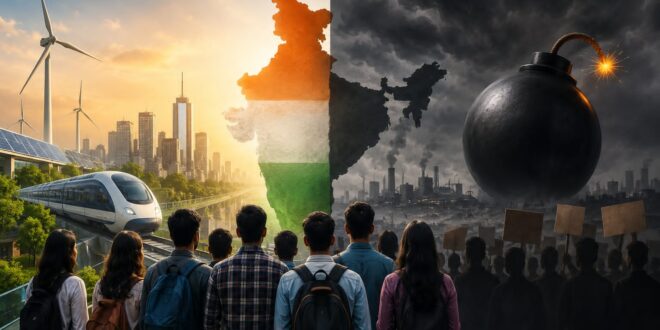
Yet demographics alone do not guarantee development. A young population is not inherently an asset; it is merely a possibility. Whether India’s demographic dividend becomes a springboard for unprecedented progress or a catalyst for social and economic instability depends entirely on the choices made today. The uncomfortable reality is that India’s demographic dividend is rapidly becoming a demographic gamble.
History offers valuable lessons. Countries such as South Korea, Singapore, and China successfully transformed youthful populations into engines of economic growth through strategic investments in education, healthcare, industrialisation, and job creation. Their demographic dividends did not materialise by accident. They were cultivated through deliberate policy interventions that equipped young people with the skills and opportunities necessary to contribute productively to the economy.
India, however, faces a more complex challenge. Each year, millions of young Indians enter the labour market with aspirations of upward mobility and financial independence. Unfortunately, the economy has struggled to generate sufficient high-quality employment opportunities to absorb this expanding workforce. While economic growth figures often dominate headlines, growth without employment risks becoming a hollow achievement.
This phenomenon, often referred to as “jobless growth,” represents one of the most pressing challenges confronting modern India. Universities continue to produce graduates, yet employers frequently report significant skill gaps. Degrees have become increasingly common, but employability remains distressingly scarce. The result is a paradoxical situation in which unemployment and labour shortages coexist simultaneously. Young people seek work, while industries struggle to find adequately trained workers.
The consequences of this mismatch extend far beyond economics. Unemployment is not merely a statistical concern; it is a social and psychological one. A generation denied meaningful opportunities may experience frustration, alienation, and declining trust in institutions. Societies thrive when citizens believe that hard work leads to progress. When that belief erodes, social cohesion often follows.
Furthermore, technological disruption adds another layer of complexity. Artificial intelligence, automation, and digital transformation are rapidly reshaping labour markets across the globe. Many traditional jobs are becoming obsolete even as new opportunities emerge. This transition demands adaptability, critical thinking, and continuous learning—skills that India’s education system has not consistently prioritised. Memorisation may help students pass examinations, but it rarely prepares them for an economy characterised by perpetual change.
Yet pessimism would be premature. India possesses extraordinary advantages that few nations can match. Its entrepreneurial culture is vibrant, its digital infrastructure is expanding rapidly, and its start-up ecosystem has become one of the world’s most dynamic. From financial technology to renewable energy, Indian innovators are demonstrating remarkable ingenuity in addressing complex challenges. The nation’s youth are ambitious, technologically adept, and increasingly connected to global opportunities.
To harness this potential, policymakers must shift their focus from merely increasing educational access to improving educational quality. Schools and universities must cultivate problem-solving abilities, communication skills, financial literacy, and technological competence. Simultaneously, governments and businesses must collaborate to expand vocational training programmes that align with evolving industry demands.
Equally important is the promotion of entrepreneurship. Not every young person will secure employment in a large corporation, nor should that be the expectation. By reducing bureaucratic obstacles, improving access to capital, and fostering innovation, India can empower young people to become job creators rather than job seekers.
The demographic dividend is often discussed as though it were a guaranteed reward waiting to be claimed. In reality, it resembles a rapidly expiring opportunity. Demographic advantages are temporary. As birth rates decline and populations age, the window eventually closes. India cannot assume that its youthful population will remain a source of competitive advantage indefinitely.
The question facing India is therefore not whether it possesses a demographic dividend. It undoubtedly does. The real question is whether the country can transform demographic potential into economic reality before time runs out.
A generation stands poised at the threshold of history. If equipped with education, skills, and opportunity, it could propel India toward unprecedented prosperity and global leadership. If neglected, it could become a source of economic stagnation and social unrest.
India’s demographic dividend is neither a blessing nor a curse. It is a test. The outcome remains unwritten.