 Telescope Today | टेलीस्कोप टुडे Latest News & Information Portal
By Pranav Mittal
Artificial intelligence is often described as the technology that will transform everything. It can analyse enormous amounts of information, automate routine tasks, generate content, and increasingly assist with complex decisions. Its potential economic impact is enormous.
But one question deserves greater attention: Who will benefit from that productivity?
AI could create an economy where businesses produce more with fewer resources and workers accomplish tasks faster. In theory, greater productivity should make societies richer. Yet higher productivity does not guarantee that prosperity will be shared equally.
Unlike many previous technologies, AI can increasingly perform tasks that once required human cognitive labour. It can write, code, analyse data, translate languages, and assist with research. Its effects could therefore extend across a much wider range of occupations.
Some workers will benefit enormously. Employees who learn to use AI effectively may become significantly more productive, while companies that integrate it successfully could gain a major competitive advantage.
Others, however, may find the value of their skills declining.
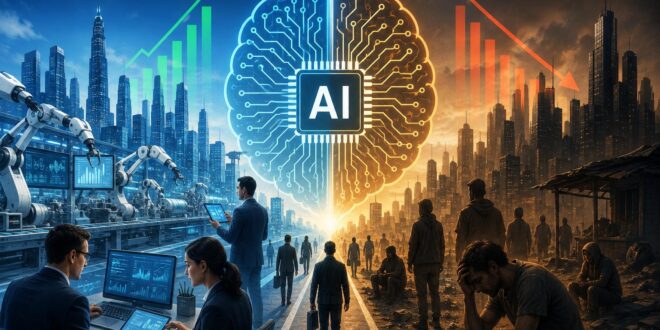
This creates a striking economic possibility: productivity could rise even as demand for certain forms of labour falls. If the gains from AI flow primarily to owners of technology, intellectual property, and capital, wealth could become increasingly concentrated even while the economy grows richer.
This is not an argument against AI. Technological progress has repeatedly transformed economies, eliminating some jobs while creating new industries and occupations. The difference today may be the speed and breadth of technological change.
If AI advances faster than workers can adapt, the transition could be disruptive. Education systems may struggle to keep pace, while governments could find traditional approaches to employment increasingly inadequate.
The answer cannot simply be to slow innovation. Preventing productive technologies from spreading would make economies less competitive without addressing the underlying challenge.
Instead, societies must ensure that people can participate in the gains AI creates. Education should place greater emphasis on adaptability, critical thinking, communication, and technological literacy. Workers will need opportunities to reskill throughout their careers, while businesses should view AI not only as a tool for reducing costs, but also as a means of expanding human capabilities.
Governments will also need to consider competition, education, social protection, and access to technology as AI reshapes markets.
The central question is not whether AI will make economies more productive. It almost certainly will.
The real question is whether productivity growth will translate into broadly shared prosperity.
AI could generate more wealth than many technologies before it. But creating that wealth is only half the challenge. The other half is ensuring that people have the skills and opportunities to share in it.
The most successful AI economy may therefore not be the one that automates the most. It may be the one that makes the greatest number of people more capable.

About the Author
Pranav Mittal is a student at City Montessori School, Cambridge Section, Lucknow, and an alumnus of La Martiniere College, Lucknow. He is passionate about economics, public policy, entrepreneurship, and social impact, and writes on issues related to economic development, youth empowerment, and sustainable growth.